
What is Agreed Capacity?
When businesses talk about energy savings, the focus usually goes straight to consumption. Use less power, improve controls, replace inefficient equipment. Those actions matter, but they are not the only place savings sit.
For many larger UK sites on site-specific billed electricity tariffs, part of the bill is tied to contracted capacity. Current DNO charging statements show that these charges can include a capacity charge in p/kVA/day for Maximum Import Capacity, or MIC, plus an exceeded-capacity charge if the site goes above its agreed level. UK Power Networks describes MIC as the maximum amount of power a property can draw from the network at any given time, measured in kVA, and notes that reducing it can save money where the site is using less than the maximum allowed.
That matters because many businesses are still paying for a level of network access that no longer reflects how the site operates today. Ofgem has also approved industry changes clarifying DNO rights where customers overuse or underuse their MIC or MEC, which shows that capacity management is a real part of the UK charging framework, not a billing footnote.
The practical opportunity is simple: if your site no longer needs the capacity it once contracted, reducing that agreed level can cut cost without changing a single kilowatt-hour of consumption. This is a billing optimisation exercise, not an efficiency project. You are not using less electricity. You are stopping the business from paying for headroom it no longer needs.
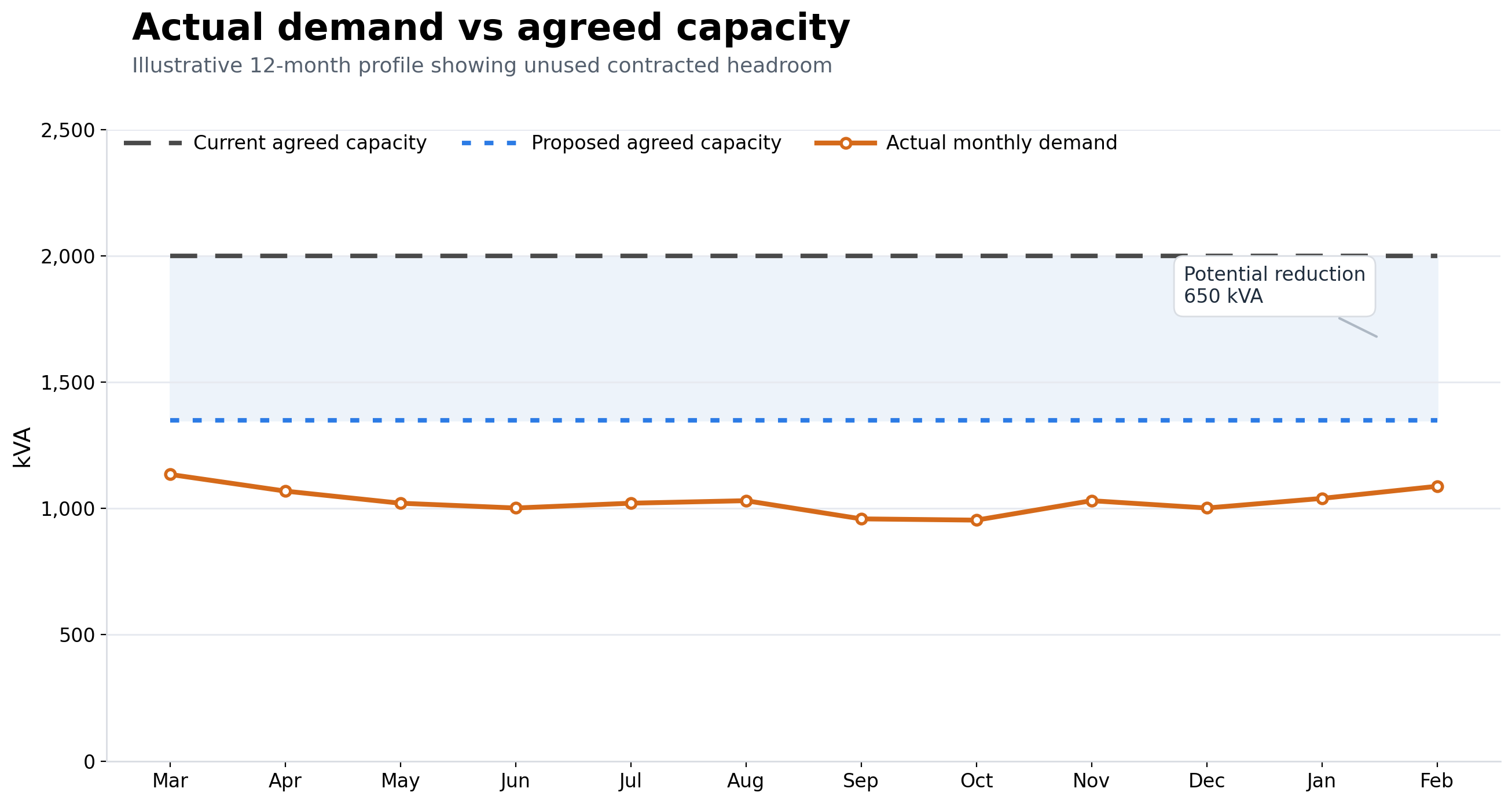
A recent client analysis makes the case clearly. In that review, the site’s contract capacity sat at 2,000 kVA, while actual used kVA was much lower through the year, broadly around 950 to 1,100 kVA. The proposed capacity appeared to fall to roughly 1,350 kVA using a 1.2 safety-factor approach. In the model, the monthly kVA cost moved from about £5,320 to about £3,591 for most months, and the projected saving on the site’s bill was £20,748 per year. The same analysis showed an average gain of 4% on the site’s total bill per month, and 20% on all kVA costs across all sites reviewed.
That is the key point. A capacity review does not need to produce a dramatic headline reduction in the total invoice to be worth doing. In this case, the total bill improvement was around 4%, but the kVA cost reduction was much sharper. That is exactly why reducing capacity deserves attention. It targets a part of the bill that is often overlooked, persistent, and largely invisible until someone compares actual demand against the contracted level.
.png?width=1385&height=317&name=Img%20(2).png)
Why sites end up over-contracted
This issue tends to appear when a site has changed over time but the agreed capacity has not. Production may have reduced. Old equipment may have been removed. Load may have been spread more evenly. Heating, cooling, and controls may have improved. Even where operations feel broadly the same, the actual peak demand profile can be very different from the assumptions that shaped the original contract.
Once that happens, the business can drift into a bad position: it keeps the cost of historic headroom but gets no real value from it. That is why capacity reviews are often most useful on mature industrial and commercial sites where the supply agreement has not been challenged for years.
How to reduce capacity safely
The right way to do this is with data and restraint.
Start with at least twelve months of demand data so you can see seasonal peaks, shutdowns, start-up events, and unusual operating days. Then identify the real maximum import level and add sensible headroom. The client deck you shared used a clear safety-factor structure: conservative at 1.5x, balanced at 1.25x to 1.4x, and aggressive at 1.1x to 1.2x for very stable sites. In that example, the 1.2x approach still left breathing room while creating a strong saving.
That safety factor matters because the aim is not to cut capacity as far as possible. The aim is to set a level that reflects genuine operating risk. A site with volatile peaks, major process starts, or planned electrification may need a wider margin. A stable site with predictable load and good controls can usually take a firmer position.
In UK practice, this also needs to line up with DNO and supplier processes. UK Power Networks says MIC reductions are handled through a revised connection agreement, that there may be lead time before the new MIC shows on bills because the supplier has to update billing, that reductions cannot be backdated, and that capacity can only be changed once within a 12 month period. SSEN’s current charging statement says much the same: no reduction for 12 months after an agreement, reductions only once in a 12 month period, and the revised lower level is agreed with reference to the customer’s maximum demand.
That means capacity should be reviewed carefully before a request goes in. It is not something to adjust casually every month in response to a short-term dip.
What can go wrong?
The obvious risk is cutting too far.
Current charging statements make clear that if a site exceeds its MIC, exceeded-capacity charges can apply. SSEN states that the exceeded portion is charged based on the gap between MIC and actual capacity used, and that this can be charged for the full month in which the breach occurs. The same statement also warns that once a lower level is agreed, the original higher capacity may not be available later without network reinforcement and associated charges.
That is why good capacity reduction is a commercial decision backed by operational evidence. Before changing anything, businesses should ask five practical questions. What was the highest genuine demand in the last year? Was it a normal event or an outlier? Are there known future loads coming, such as EV charging, new HVAC plant, or production growth? How much headroom does the site need to stay operationally comfortable? And is the business willing to live with that number for the next year?

Why this is such a strong savings opportunity
Reducing capacity sits in a useful middle ground. It is more grounded than a generic bill audit, but it is often quicker and cheaper than a physical energy project. In many cases, the hard work is analysis, validation, and contract change rather than capital spend.
That is why it can be a strong move for procurement teams, finance leaders, and energy managers under pressure to find savings now. You are correcting the commercial settings around the site, based on what the site actually does, rather than what it used to do.
The client example shows the value of that approach. One site review pointed to more than £20,000 a year in savings at a single site, with a meaningful drop in monthly kVA cost and a 4% improvement on the total bill. That is a serious result for a change that comes from right-sizing agreed capacity rather than installing new hardware.
.png)